Category: English

  • Israel Independence Day – 5783

    Israel Independence Day – 5783

    One of the greatest miracles of our time is the re-establishment of the State of Israel 75 years ago. The promise of the Creator to bring His people back from exile to their ancient homeland began to materialize before our eyes, and each year Israel celebrates that ongoing marvel.

    There’s good reason for every believer in the world – not just the people living in Israel – to thank GOD for the nation’s existence, with the song: “Give thanks to the LORD, for He is good; for His mercy is everlasting.… This is the day which the LORD has made; let’s rejoice and be glad in it.” (Ps. 118:1, 24)

    But not everyone is glad about Israel’s reappearance in the world. The UN General Assembly, for example, publishes more condemnations against the Jewish state each year than against the rest of the world combined. These are usually approved by a large majority of member-nations, and with every passing year the “resolutions” become more extreme. At the end of 2022, the UN voted to remember Israel’s establishment in 1948 as a disaster (“Nakba”). As a result, this year on May 15, the UN will hold an event at their New York headquarters to officially promote the idea that Israel should never have been permitted to exist – within any borders. This outrageous proposal was adopted by a vote of 90 to 30, with 74 (cowardly) abstentions and no-votes.

    Watching this growing opposition, we realize how miraculous Israel’s ongoing success really is. The LORD of all the earth has simply overruled the nations. Just as He moved King Cyrus to declare the end of the first Jewish exile in 538 BCE, He moved the UN in 1947 (against all odds) to declare an end to the second Jewish exile, and again in 1949 to accept Israel as a sovereign nation. He frustrated repeated attempts by Israel’s enemies to destroy the new state, and in 1967 He caused Israel to widen its territory – something that the IDF wasn’t even planning to do! Suddenly, the Biblical heartland of Judea and Samaria, all of Jerusalem, and the Temple Mount, were in Jewish hands again.

    That was when the UN began its onslaught of condemnations against Israel, even to the point of ridiculously denying that the Temple Mount has any connection to the Jewish Temples that stood there for centuries and gave it that name.

    But the Creator’s decree still stands, and the exiled people are still returning. “The LORD builds up Jerusalem, He gathers the outcasts of Israel.” (Ps. 147:2) “And the redeemed of the LORD will return
    and come to Zion with joyful shouting,” (Isa. 51:11)

    The “dry bones” (Ezek. 37) who were “completely cut off” were brought back to their own land, and despite opposition from their enemies, they were put back together “bone to its bone” as one recognizable people. While the world watches, the “breath / wind / Spirit” (the Hebrew word ruach means all three) is gradually filling them with a deeper and fuller life.

    Sometimes it seems that Israel’s spiritual life is faltering or going astray. But GOD assures us that once His miracle has begun, it cannot be stopped. “Can a nation be given birth all at once? As soon as Zion was in labor, she also delivered her sons. ‘Shall I bring to the point of birth but not give delivery?’ says the LORD. ‘Or shall I who gives delivery shut the womb?’ says your GOD.” (Isa. 66:8-9)

    In Ezekiel’s vision, the LORD spoke of bringing His people out of their “graves” to Israel. The Nazi death camps were the most obvious examples, but more subtle graves exist in the Exile… comfortable places where the Jewish people have lost touch with GOD, the Source of their life as Jews, and they don’t even know that they’ve died.

    However, many Jewish people around the world, who never cared about their identity, report that when they visit Israel something “wakes up” inside them. Some feel an immediate sense of belonging, of “coming home”, even though they’ve never been here before. Others begin to think about GOD, perhaps for the first time in their lives.

    “And I will attach tendons to you, make flesh grow back on you, cover you with skin, and put breath [or, spirit] in you so that you may come to life; and you will know that I am the LORD.” (Ezek. 37:6)

    People who embrace Replacement Theology, which teaches that GOD has abandoned the Jewish people and the Christians are now “Israel”, have great difficulty explaining the rebirth of physical Israel. They have failed to consider the Creator’s solemn declaration:

    “If this fixed order [of the sun and moon] departs from Me, then the descendants of Israel also will cease to be a nation before Me forever… If the heavens above can be measured and the foundations of the earth searched out below, then I will also reject all the descendants of Israel
    for everything that they have done.” (Jer. 31:36-37)

    Israel’s exile was punishment for our sins; it’s written clearly in the Scriptures. But this stage of restoration is written just as clearly. The Maker of Heaven and Earth, who scattered His people for disobedience, is a loving Father who takes pity on His homeless people.

    Moreover, He has sent out a call to His people who belong to the nations, to partner with Him in this restoration program: “Behold, I will lift up My hand to the nations and set up My flag to the peoples; and they will bring your sons [Zion] in their arms, and your daughters will be carried on their shoulders.” (Isa. 49:22)

    The promise goes all the way back to the Torah: “The LORD your GOD will restore your captivity…” (Deut. 30:3). But the Hebrew text says something even more amazing: The verb here is not yashiv (“bring back) but shav (“come back) – literally, “the LORD your GOD will return with your returning captives.”

    The same thing appears in the famous verse, “When the LORD brought back the captives of Zion, we were like those who dream.” (Ps. 126) In Hebrew it reads: “In the return of the LORD with the return of Zion….” When the people come back to Zion, the Holy One comes back with them. No wonder it feels like a dream!

    It is also written: “The LORD has chosen Zion; He has desired it as His dwelling place.” (Ps. 132:13) Some would argue that it doesn’t “look like” the LORD is dwelling in Zion, or anywhere in modern Israel. But as human beings, our view is limited to what’s visible in the present. This is why we need to rely on the Scriptures, which tell us of unseen things and things yet to come.

    The Creator is well aware that His chosen city is not yet fulfilling its holy calling. That’s why He has called for His believers to pray for that day – and even to “nag” Him about it:

    “On your walls, Jerusalem, I have appointed watchmen. All day and all night they will never keep silent. You who profess the LORD, take no rest for yourselves, and give Him no rest, until He establishes and makes Jerusalem an object of praise on the earth.” (Isa. 62:6-7)

    Someday the world will no longer question the legitimacy of Israel or the holiness of Jerusalem:

    “The LORD roars from Zion and utters His voice from Jerusalem, and the heavens and the earth quake! But the LORD is a refuge for His people, and a stronghold for the sons of Israel. Then you will know that I am the LORD your GOD, dwelling on Zion, My holy mountain. So Jerusalem will be holy, and strangers will no longer pass through it.” (Joel 3:16-17)

    Now is the time for all His believers to praise Him for what is to come, to join with the regathered people of Israel as they celebrate His mighty work of resurrecting their nation:

    “Give thanks to the LORD, for He is good, for His mercy is everlasting. The redeemed of the LORD shall say so, those whom He has redeemed from the hand of the enemy and gathered from the lands, from the east and from the west, from the north and from the south.” (Ps. 107:1-3)

    Be blessed by the Most High, from Zion and Jerusalem,

    Mordechai ben Yakov

  • Holocaust Memorial Day

    Holocaust Memorial Day

    The subject of the Holocaust (Heb: Ha-Shoah) always reminds me of a Psalm written by Asaph:

    “GOD, do not remain quiet; do not be silent and, GOD, do not be still! For behold, Your enemies make an uproar, and those who hate You have exalted themselves. They make shrewd plans against Your people, and conspire together against Your treasured ones. They have said, ‘Come, and let’s wipe them out as a nation, so that the name of Israel will no longer be remembered.’” (Ps. 83:1-4)

    This tells us that such “shrewd plans” were not confined to the horrors of 80 years ago in Nazi Germany. Hatred of Israel started with the appearance of the people of Israel in history. It has raised its ugly head in every generation, and it continues to our days.

    Students of history too easily brand the Nazis as barbarians. In reality they were fans of enlightenment, the arts, and refined European manners. In the same way, the Pharoah who enacted his genocide against the Hebrews, and Haman who designed a genocide against the Jewish exiles, were both ruling over advanced, powerful nations with great cultural traditions.

    What drives such hatred among well-educated people? This is difficult to answer, because every wave of Jew-hatred claims a different basis: religious, social, economic, political, or some other friction.

    Their common claim is that the Jews are some kind of threat to non-Jews. But again, both Pharoah and Haman attacked the descendants of Israel during times of prosperity, when their victims were already submissive and supportive of their rule. Likewise, Hitler had the support of patriotic German Jews at first, with no reason to fear them.

    The reasons why the Jews are supposedly a threat are not even consistent. “They are too religious / too secular / too poor / too wealthy / too liberal / too conservative / too detached / too involved….” When the Jewish people wandered around the world with no country of their own, nations repeatedly expelled them. But now that they do have a country of their own, people are offended and tell them to “go back where you came from.”

    Israel’s ancestral land gets the same irrational treatment. It was abandoned and neglected for centuries after the Roman exile – a sparsely populated sliver of sand, rocks and swamp that no one wanted – until Jewish pioneers returned in the early 20th century. Suddenly, Israel’s neighbors desired the same land for themselves… and they’ve been fighting over every square meter since then.

    This also is not new; the Philistines did the same in Isaac’s days. They blocked up the wells Abraham had dug, making them unusable… only to claim them as “ours” when Isaac reopened them (Gen. 26:18-21). Their envy inspired them to chase Isaac away because he was so successful (v. 14-16) – and then to chase after him to make an alliance (v. 26-29) for the same reason!

    This response is not rational but spiritual. The Philistines were honest about that; they confessed to Isaac, “We have seen plainly that the LORD has been with you.” (v. 28) The descendants of Abraham, Isaac and Jacob represent GOD in the world and are accompanied by Him.

    Readers of the Scriptures sometimes think that this is no longer true. The LORD has expressed anger against His people, and has punished them for their sins, which must mean He has rejected Israel. Thus, the nations are free to do whatever they want with the Jewish people. Hitler even declared that he was doing GOD’s work, and a significant number of Christian leaders supported him.

    However, Hitler’s “work” had no parallel in history. He tried to locate, isolate and exterminate even the most assimilated Jews (including church members who had renounced their Jewishness). He carried that goal beyond his own country and culture, seeking partners in Africa and the Muslim world. He even disregarded practical interests – sacrificing talented doctors, musicians, businessmen, and inventors just to create a Judenrein (Jew-free) regime. And when Hitler saw that he was losing the war, he redoubled his efforts to kill more Jews.

    The motive could only have been spiritual. Hitler was waging war on the GOD who called this people into being, and who promised to regather them back to their own land.

    No matter how much we describe the Holocaust, our minds cannot grasp the losses suffered by each family that it touched. The pain is made worse by those who deny the magnitude of the destruction, or its unique character. As the years pass and the eyewitnesses leave this world, the Holocaust deniers are becoming bolder. A Dutch group is now perversely claiming that the famous diary of Anne Frank (the German-Jewish girl hidden with her family in Amsterdam while the Nazis rounded up Jews for extermination) is a fictitious story.

    But sooner or later, all those who abuse GOD’s people will experience catastrophes: “Israel was holy to the LORD, the first of His harvest. ‘All who ate of it became guilty; evil came upon them,’ declares the LORD.’” (Jer. 2:3)

    It’s vital to note that most foreign translations of this verse are wrong. The Hebrew does not use the past tense, “was holy” – “became guilty” – “evil came.” It is present tense: “Israel IS holy to the LORD;” – and future tense: “All who eat of it WILL BECOME guilty; evil SHALL COME upon them.”

    To this day, the Creator views attacks on Israel as a personal offense: “For the LORD of Armies says this: “After glory He has sent me against the nations that plunder you [Zion], for the one who touches you, touches the apple of His eye.’” (Zech. 2:8 – v. 12 in Hebrew)

    Notice that vengeance can come for lesser offenses than attempted genocide; plundering Zion’s possessions is enough to trigger the LORD’s opposition.

    In contrast to all these haters are the lovers of Zion, especially the believers in the Creator from the nations. Because they love the GOD of Israel, they love the people He has chosen. They recognize the guilt that their nation shares either directly (cooperating with the Nazis) or indirectly (refusing to take in Jewish refugees fleeing the Nazis).

    On Israel’s Holocaust Memorial Day, we stand together, Jews and non-Jews, to remember those who were murdered by gas, starvation, disease, firing squads and torture; as well as those trapped in the concentration camps who somehow survived. We also remember those who escaped the deadly dragnet (often miraculously) and hid in plain sight, or who joined the underground resistance.

    Last but not least, we remember the brave people who risked their lives to save Jews, sometimes losing their own lives in the process. Israel’s Holocaust Museum, Yad Vashem, has a section dedicated to these righteous Gentiles – nearly 30,000 individuals from 51 countries. Interestingly, the Yad Vashem site confesses that the question of why these people decided to help Jewish strangers, despite the danger to themselves and their families, has no “rational explanation.” Indeed, the only explanation is a spiritual one.

    There is debate among Israel’s supporters about whether the revived modern state of Israel is because of the Holocaust, or in spite of it. Here’s why I (and many others) believe it’s the latter.

    The survivors of the Nazi camps were actively barred by the British from entering Mandate Palestine. Those who were smuggled past the blockades were malnourished “skeletons” who had to keep fighting for survival, dealing with armed Arab attacks while the British confiscated Jewish weapons. There was also malaria, poverty, and a shortage of basic necessities. Yet this collection of “dry bones” somehow “came together, bone to its bone,” and grew flesh, tendons and skin (Ezek. 37:7) to become a nation. Against all odds, they “came to life and stood on their feet, an exceedingly great army.” (v. 10)

    The IDF is not free of shortcomings. But is it coincidence that Israel’s small army is ranked by US News & World Report as the fourth strongest in the world today – surpassed only by Russia, the USA and China? In its 75-year history, Israel has won seven wars, and survived numberless terror attacks and rocket attacks. Many countries are eager to buy Israel’s military technology.

    “At the proper time it shall be said to Jacob and to Israel what GOD has done! Behold, a people rises like a lioness, and like a lion it raises itself.” (Num. 23:23-24)

    Yes, GOD has built Israel’s army, and He fights alongside them. When enemies again threaten our existence, He “will protect the inhabitants of Jerusalem, and the one who is feeble among them on that day will be like David.” (Zech. 12:8) Although still too young to serve in the army, David came against Goliath “in the name of the LORD of Armies, the GOD of the armies of Israel, whom you have defied.” (1 Sam. 17:45)

    We can debate whether the process of the “dry bones” being filled with the LORD’s Spirit (Ezek. 37:14) is finished yet, but it’s clear that we’ve passed one stage (v. 12-13): “Behold, I am going to open your graves and cause you to come up out of your graves, My people; and I will bring you into the land of Israel. Then you will know that I am the LORD, when I have opened your graves and caused you to come up out of your graves, My people.”

    Consider how precisely this promise was fulfilled. The prophet Ezekiel couldn’t have imagined the Nazi death camps, but they were quite literally graves for millions, and potential graves for many whose “bones were dried up” and whose “hope had perished” (v. 11). No other kind of “grave” could be opened and depopulated without a physical resurrection.

    I am personally the second generation after the Holocaust, as are many other Israelis. We remember and mourn the murdered, even as we comfort and care for the few survivors still with us. But another task on this day is to remember what our GOD has done for us, and declare it to the world:

    “He has revealed His righteousness in the sight of the nations. He has remembered His graciousness and His faithfulness to the house of Israel. All the ends of the earth have seen the salvation of our GOD!” (Ps. 98:2-3)

    Blessings from the Most High be upon you, from the land of Zion and Jerusalem,

    Mordechai ben Yakov
  • The seventh day of Passover – splitting the sea!

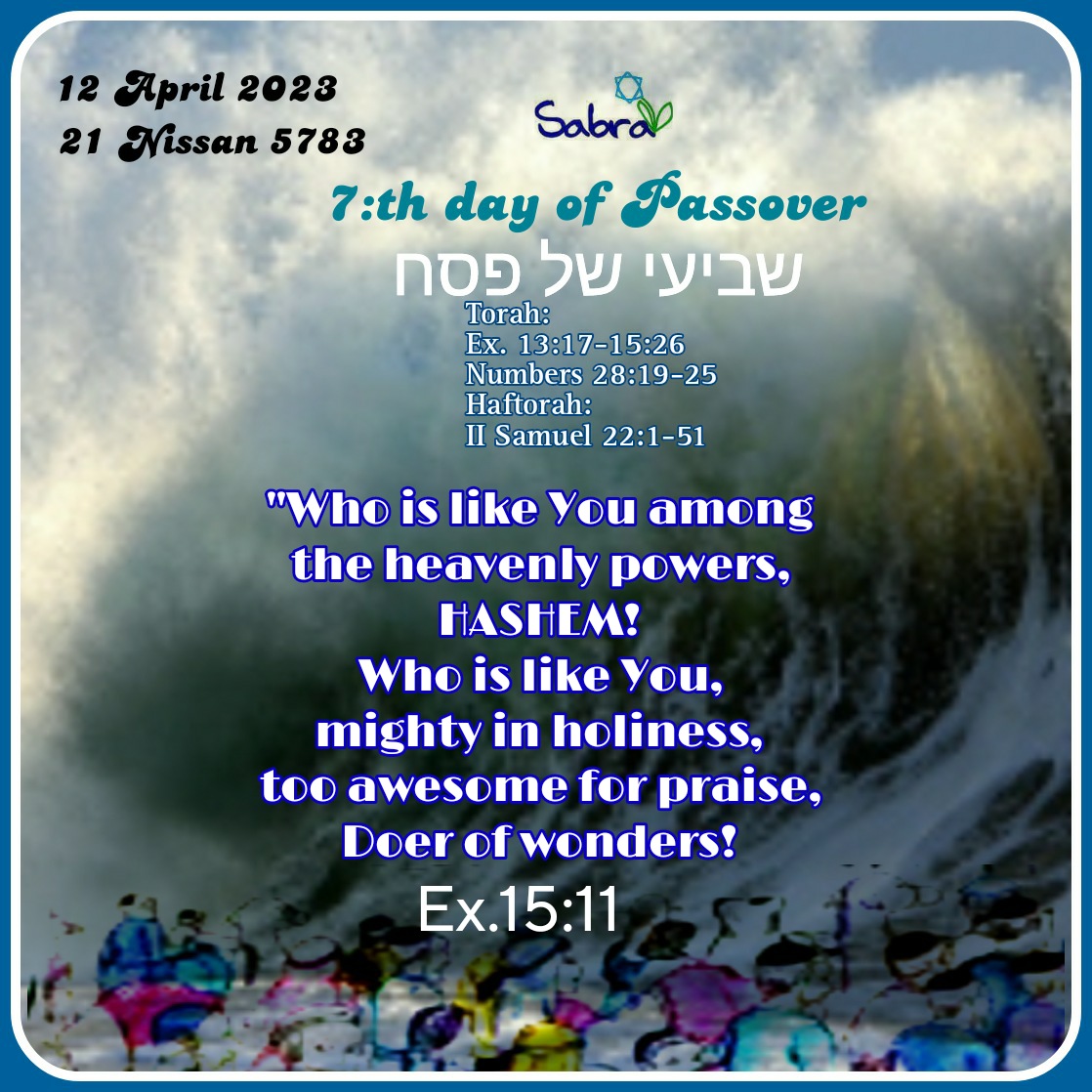
    The seventh day of Passover – splitting the sea!

    Happy Passover, my dear friends.

    According to the Torah, we are commanded to celebrate Passover for seven days. The first day is a rest-day called a shabbaton, or “little sabbath”. So is the seventh day. Both commemorate great wonders performed by the Creator while redeeming His people from Egypt.

    On the first day was the pesach, which is translated as “passing over” but literally means “hopping”. The Holy One went through the land of Egypt and struck down the firstborn in every house that did not have the blood of a lamb on its doorposts… regardless of whether it was an Israelite or Egyptian house. But He skipped over every house that did have the blood… regardless of whether the trusting family was Israelite or Egyptian.

    The seventh day saw a similar miracle, called in Hebrew Kriyat Yam Suf, literally “the tearing open of the Sea of Reeds”. Here too, a distinction was made between the Creator’s obedient people, who walked through the walls of water on dry land, and His defiant enemies, who were caught in the collapsing walls and drowned. They realized too late that “the LORD is fighting for them against the Egyptians” (Exod. 14:25).

    This sort of thing still happens today. Even when it is foretold by the prophets that Israel will never cease to be a nation as long as the sun is shining (Jer. 31:35-36), Israel’s enemies continue to “conspire together… saying, ‘let’s wipe them out as a nation…’” (Ps. 83:3-4)

    Indeed, centuries beforehand the Creator told Abraham the entire Exodus story: his descendants would “be enslaved and oppressed for four hundred years. But I will also judge the nation whom they will serve, and afterward they will come out with many possessions.” (Gen. 15:13-14) This included material wealth like Egypt’s silver and gold, and spiritual wealth like the Holy One Himself escorting them in a Pillar of Cloud and Fire.

    But just fresh out of slavery, the Israelites were new to this whole idea of walking with GOD. As they left the cities of Egypt behind, they were in high spirits, for they could see that “the LORD was going before them in a pillar of cloud by day to lead them on the way, and in a pillar of fire by night to give them light.” (Exod. 13:21) It was easy to go out “boldly in the sight of all the Egyptians” while their former masters were mourning and “burying all their firstborn” (Num. 33:3-4). But after seven days of elation, they reached a dead-end, with the sea in front, the desert on either side, and the dreaded enemy coming behind them.

    And it seemed… just for a short while… that trusting the LORD’s salvation was a mistake.

    Perhaps the Cloud and Fire were just an illusion that Moses had conjured up? No, a conjured vision couldn’t sustain itself with nearly a million people for seven days and nights, nonstop (Exod. 13:22). Perhaps they had misunderstood the directions? No, the directions were clear: “Turn back and camp in front of Pi-hahiroth, between Migdol and the sea; you shall camp in front of Baal-zephon, opposite it, by the sea.” (Exod. 14:2)

    In short, the Creator intended for them to be trapped! “For Pharaoh will say of the sons of Israel, ‘They are wandering aimlessly in the land; the wilderness has shut them in.’ And I will harden Pharaoh’s heart, and he will chase after them; and I will be honored through Pharaoh and all his army, and the Egyptians will know that I am the LORD.” (v. 3-4) To provoke that action, the Creator arranged for the king and his servants to hear “that the people had fled,” (v. 5) and then He made sure that the Egyptian army successfully tracked the Israelites to their camp by the sea (v. 9) – a journey of two or three days.

    This is a pattern with the Holy One. When He lets His people know exactly what enemies will do, He doesn’t immediately spell out what He will do in response. Our part is difficult but rewarding: Wait, watch, and trust that He is “up to something”.

    Again, though, the Israelites were new at this. First, they did the right thing; they cried to the LORD (v. 10). But waiting was too hard when you could see the dust of the Egyptian chariots approaching, and there was nowhere to hide. They turned on Moses – they blamed him for the “mistake” of thinking that they could walk away from slavery.

    Moses’s answer: “Do not fear! Stand by and see the salvation of the LORD… The LORD will fight for you, while you keep silent.” (v. 13-14). But he himself couldn’t resist the panic; he also cried to the LORD! (v. 15)

    Implied in the Creator’s answer is the idea that He was ready to give more instructions… once Moses calmed down enough to act on them. (As the leader of a great nation, he was also new at this.)

    The lesson for us? When we call on the Creator for help, it’s not enough to express our fears and hopes, or to ask, “Where are You??!” We should expect the help that we are asking Him to send, and be ready to move with it the moment it arrives!

    And yet, as we see in the crossing of the Sea, accepting the Holy One’s miraculous help may also take courage. Imagine walking on a dirt path between two giant quivering walls made of water… in a huge crowd that prevents you from backing out!

    Faith is not passive, but active. We must find out what the Creator intends to do, and then follow Him in the doing. “All nations surrounded me; in the name of the LORD I will certainly fend them off… I will give thanks to You, for You have answered me, and You have become my salvation.” (Ps. 118:10, 21) On the other hand, this favor is not earned; it is given as soon as we begin to trust: “The one who trusts in the LORD, lovingkindness will surround him.” (Ps. 32:10)

    We also need to recognize that the Creator doesn’t always deliver His people from physical harm. The hardest challenge to waiting and trusting GOD was in the Holocaust, when millions of Jews were sent to their deaths. The story is told about one such “death train” headed for an extermination camp, packed with crying children and parents trying to soothe them while inwardly agonizing over their fate. As some were praying, one person began singing the traditional song, “I believe with perfect faith in the coming of the Messiah… and even if he delays, I will still wait every day for him to come.”

    Some were miraculously rescued from that horror, which is why we have eyewitness testimonies. Most were not rescued. Some Jews lost their faith as a result; some found their faith strengthened. Regardless, there is no doubt that the Holy One heard every suffering person, just as He heard the crying of His people in Egypt.

    After instructing Moses on how work with Him, the Holy One repeated His goal: Take the Israelites through the sea on dry land, provoke the Egyptians to chase them, and then… be “honored” in some way still not revealed. “And the Egyptians will know that I am the LORD.” (Exod. 14:4, repeated in v. 18) Only when Moses took action did GOD also take action, effortlessly sending the Egyptians into a panic and receiving the honor that He spoke of (v.24-25).

    We who have the advantage of knowing the holy Scriptures can recognize this announcement as a prelude to supernatural action, a deed that could only be attributed to the Lord of heaven and earth. The promise that someone “will know that I am the LORD” occurs in the Tanach over 50 times, and all of them are impossible situations. Seven times it relates to the redemption of Israel from Egypt. Others are about the beginning – and end – of Israel’s exile, and the judgment of the wicked. One refers to the holiness of Zion in the End of Days:

    “Then you will know that I am the LORD your GOD, dwelling on Zion, My holy mountain. So Jerusalem will be holy, and strangers will no longer pass through it.” (Joel 3:17)

    The slavery in Egypt, the Exodus and the parting of the Sea are used as metaphors in a prophecy of Israel’s return from worldwide exile. And as with the original Passover miracles, this also is something only the Holy One can do:

    “’When I scatter them among the peoples, they will remember Me in distant countries, and they with their children will live and come back. I will bring them back from the land of Egypt and gather them from Assyria; and I will bring them into the land of Gilead and Lebanon until no room can be found for them.

    “’And they will pass through the sea of distress, and He will strike the waves in the sea, so that all the depths of the Nile will dry up. And the pride of Assyria will be brought down, and the scepter of Egypt will depart. And I will strengthen them in the LORD, and in His name they will walk,’ declares the LORD.” (Zech. 10:9-12)

    When the Creator performs a miraculous act with Israel, it has a ripple effect.

    “So the LORD saved Israel that day from the hand of the Egyptians, and Israel saw the Egyptians dead on the seashore. When Israel saw the great power which the LORD had used against the Egyptians, the people feared the LORD, and they believed in the LORD and in His servant Moses.” (Exod. 14:30-31)

    Israel wasn’t the only nation to be deeply impressed. Forty years later, Rahab of Jericho told Joshua’s spies that the Canaanites had “heard how the LORD dried up the water of the Sea of Reeds before you when you came out of Egypt… When we heard, our hearts melted and no courage remained in anyone any longer because of you; for the LORD your God, He is GOD in heaven above and on earth below.” (Josh. 2:10-11) 

    And far into the future, many nations would hear about Israel’s amazing GOD and would say to one another, “Come, let’s go up to the mountain of the LORD, to the house of the GOD of Jacob, so that He may teach us about His ways, and that we may walk in His paths.” (Isa. 2:3)

    And that is His ultimate purpose for “baring His holy arm in the sight of the nations – So that all the ends of the earth may see the salvation of our GOD.” (Isa. 52:10) People in every generation, from every nation on earth, will put their faith in Him, forming an unbreakable chain of testimony: “He alone is GOD in heaven and on earth.”

    Far from being obsolete, believers in the Creator need to speak up today more than ever. In spite of our digital world claiming that yesterday’s news is not relevant, people are desperate to grab onto something that will not change under the pressures of momentary fads, drifting boundaries, or bullying mobs. In spite of the endless forms of escape from depression through drugs, trances or “virtual reality”, people are hoping that somewhere, someone will tell them that they are not random accidents in an uncaring universe – but rather they are called into being for a purpose, by Someone who loves them and can guide them into fulfilling, meaningful lives.

    In spite of the world falling into moral darkness while we watch helplessly, people long to believe that there is a bright Day of Judgment coming, when all wrongs will be made right – when the LORD’s righteous king, the Messiah, will bring an end to corruption, betrayal and abuse. 

    “And He will delight in the fear of the LORD, and He will not judge by what His eyes see, nor make decisions by what His ears hear. But with righteousness He will judge the poor, and decide with fairness for the humble of the earth. And He will strike the earth with the rod of His mouth, and with the breath of His lips He will slay the wicked. Also righteousness will be the belt around His hips, and faithfulness the belt around His waist.” (Isa. 11:3-5)

    We who expect that blessed Day are standing in a long, long line with others who came before us. We declare with Israel’s forefather Jacob: “For Your salvation I wait, LORD!” (Gen. 49:18) We repeat the words of Israel’s great king David to the rest of humanity: “Sing to the LORD, all the earth! Proclaim good news of His salvation from day to day. Tell of His glory among the nations, His wonderful deeds among all the peoples.” (2 Chron. 16:23-24)

    The song that Israel sang on the other side of the split Sea of Reeds says it best (Exod. 15:2):

    “The LORD is my strength and song,
    And He has become my salvation;
    This is my GOD, and I will praise Him;
    My father’s GOD, and I will exalt Him!”

    May we stand shoulder to shoulder in our declaration of faith in the living GOD.

    Be blessed by the Most High, from Zion and Jerusalem,

  • Passover 5783  “By this you will know that I am the LORD.”

    Passover 5783 “By this you will know that I am the LORD.”

    The story of Israel’s exit from Egypt is much like a pregnant woman approaching her “due” date for giving birth. The Hebrew slaves must have felt the same excitement, wonder and fear – for this was nothing less than the birth of a nation.

    Moses was sent with a message to the powerful ruler of Egypt, and the words have become world-famous as the theme of Passover: “The LORD, the GOD of the Hebrews, sent me to you, saying, ‘Let My people go, that they may serve Me.’” (Exod. 7:16)

    And because the words are so familiar, we can miss the bold challenge in this simple message: “Admit that these are not your people; they belong to Me. And their purpose in life is to serve Me, not you.”

    Pharoah’s response is equally famous: “Who is the LORD that I should obey His voice to let Israel go?” (Exod. 5:2) He was foolhardy to refuse the Creator of Heaven and earth, but we must admit that he was supported by “the facts on the ground” for generations. If this GOD was real, why didn’t He claim His people during 400 years of Hebrew slavery?

    We aren’t told why, but we are told that He knew the end from the beginning. The Creator shared His Passover plan with His friend Abram, at the Covenant Between the Parts, long before His “people” existed:

    “Then GOD said to Abram, ‘Know for certain that your descendants will be strangers in a land that is not theirs, where they will be enslaved and oppressed for four hundred years. But I will also judge the nation whom they will serve, and afterward they will come out with many possessions.’” (Gen. 15:13-14)

    They would “come out” under the leadership of a man who wasn’t a charismatic leader, and who didn’t see himself as a leader at all (Exod. 3:11). GOD’s choice repeatedly tried to refuse the assignment (Exod. 4:10-13). And early in the confrontation with Pharoah, Moses already felt like a failure: “LORD, why have You brought harm to this people? Why did You ever send me? Ever since I came to Pharaoh to speak in Your name, he has done harm to this people, and You have not rescued Your people at all.” (Exod. 5:22-23)

    But here again, the Torah testifies that the LORD knew from the beginning that this would happen. What’s more, He had shared His planned response with Moses at the Burning Bush: “But I know that the king of Egypt will not permit you to go, except under compulsion. So I will reach out with My hand and strike Egypt with all My miracles which I shall do in the midst of it; and after that he will let you go.” (Exod. 3:19)

    Before Moses met with Pharoah, GOD had already spoken of the tenth plague: “When you go back to Egypt, see that you perform before Pharaoh all the wonders which I have put in your power; but I will harden his heart so that he will not let the people go. Then you shall say to Pharaoh, ‘This is what the LORD says: “Israel is My son, My firstborn. So I said to you, ‘Let My son go so that he may serve Me’; but you have refused to let him go. Behold, I am going to kill your son, your firstborn.”’” (Exod. 4:21-23)

    Yet when Moses seemingly forgot the plan, the Creator didn’t rebuke him. He patiently repeated it: “Now you shall see what I will do to Pharaoh; for under compulsion he will let them go, and under compulsion he will drive them out of his land.” (Exod. 6:1) Moses’s protest against the idea of going back to Pharoah (v. 12) didn’t receive a rebuke either. Instead, the Torah takes an odd detour, reciting some lineage that finally ends with Moses (v. 14-26). What is its purpose? To show that Moses was right – he was not qualified for leadership – not by earthly standards. His tribe was not the firstborn of Israel, his clan was not the firstborn in the tribe of Levi, nor was Moses (or Aaron) the firstborn in their family. Yet three times (v. 26-27) we are told that the LORD deliberately chose Moses. 

    How could a man of such humble origins dare to make demands of an Egyptian king, who was also revered as a deity? Because “I am the LORD.” (v. 29)

    Once more, the Creator announced not only His knowledge of the future, but His control over it: “But I will harden Pharaoh’s heart, so that I may multiply My signs and My wonders in the land of Egypt. When Pharaoh does not listen to you, I will lay My hand on Egypt and bring out My armies, My people the sons of Israel, from the land of Egypt by great judgments.” (Exod. 7:3-4)

    The end goal? “Then the Egyptians shall know that I am the LORD.” (v. 5) This is repeated many times in the Passover story (Exod. 6:7, 7:17, 14:4, 14:8).

    The Maker of Heaven and earth was sending a message to all future generations of mankind, and especially to the people of Israel. It was – and always will be – the LORD alone who delivers His people, by whomever He chooses, following a plan that He has made from the beginning. Every attempt to resist Him is foreknown and will only further His own plans.

    When a situation looks hopeless, the Creator has merely set the stage to do what makes Him famous… CREATE!

    Even when the people of Israel are reduced to a heap of “dry bones,” they will spiritually come alive, physically return to their own land… and everyone will know that there’s only One who could be responsible:

    “Son of man, these bones are the entire house of Israel; behold, they say, ‘Our bones are dried up and our hope has perished. We are completely cut off.’ Therefore prophesy and say to them, ‘This is what the LORD GOD says:
    “Behold, I am going to open your graves and cause you to come up out of your graves, My people; and I will bring you into the land of Israel. Then you will know that I am the LORD, when I have opened your graves and caused you to come up out of your graves, My people. And I will put My Spirit within you and you will come to life, and I will place you on your own land. Then you will know that I, the LORD, have spoken and done it.”’” (Ezek. 37:11-14)

    On Passover Eve, the Jewish people recline at the Seder meal to repeat the details of the supernatural display of our GOD’s power in Egypt nearly 4000 years ago. On that night, we recognize our kinship as one people across the world and across the centuries. We acknowledge, with our cups of wine raised high, that “in every generation” we, the Family of Israel, have seen a replay of this deliverance.

    The LORD doesn’t always reveal His plan in advance, or perform obvious miracles that suspend the laws of nature. He sometimes delays His confrontation with those who “rise up to annihilate” His people. But He always shows up before our enemies can succeed, and “He rescues us from their hand.”

    Our enemies always follow Pharoah’s line of thinking: “I do not know the LORD, and I also will not let Israel go.” (Exod. 5:2) Some deny the existence of the LORD, while others (like Replacement Theology teachers) deny the legitimacy of Israel; but all are essentially denying the reality that the nation of Israel belongs to the LORD for as long as night follows day (Jer. 33:23-26).

    There are other, more subtle attempts to erase the Jewish people by attacking their distinct identity. Israel cannot ever be just another nation: “The LORD your GOD has chosen you to be a people for His personal possession out of all the peoples who are on the face of the earth.” (Deut. 7:6, 14:2) Anyone who urges the descendants of Abraham, Isaac and Jacob to ignore the commands the LORD gave Israel “for all generations,” or who claims that He changed His mind and abolished them, is refusing to “let Israel go that they may serve Me.” They have joined Pharoah in asking, “Who is the LORD that I should obey His voice” concerning Israel?

    When the LORD makes Himself known to the nations, He tends to do it through His people Israel. “Then the nations will know that I am the LORD, when I show Myself holy among you in their sight.” (Ezek. 36:23) “And the nations will know that I am the LORD who sanctifies Israel, when My sanctuary is in their midst forever.” (Ezek. 37:28)

    He also makes Himself known to the world by restoring the people of Israel to their land: “When the LORD brought back the captives of Zion, we were like those who dream. Then our mouth was filled with laughter and our tongue with joyful shouting; then they said among the nations, ‘The LORD has done great things for them.’” (Ps. 126:1-2)

    Israel’s enemies will know it too… but they will respond differently: “It will be to Me a name of joy, praise, and glory before all the nations of the earth, which will hear of all the good that I do for them [Israel and Judah], and they will be frightened and tremble because of all the good and all the peace that I make for it [Jerusalem].” (Jer. 33:7-9)

    Conversely, when the LORD wants to reveal Himself to wayward Israel, He intends to do it through the Gentiles who help Him in that restoration:

    “Behold, I will lift up My hand to the nations and set up My flag to the peoples. And they will bring your sons in their arms, and your daughters will be carried on their shoulders. Kings will be your guardians, and their princesses your nurses…. And you [Zion] will know that I am the LORD.” (Isa. 49:22-23)

    “You will also suck the milk of nations, and suck the breast of kings. Then you will know that I, the LORD, am your Savior and your Redeemer, the Mighty One of Jacob.” (Isa. 60:6)

    He can even use a Gentile leader who doesn’t know Him, and through him cause the whole world to acknowledge both GOD and His people:

    “For the sake of Jacob My servant, and Israel My chosen one, I have also called you [Cyrus] by your name; I have given you a title of honor though you have not known Me…. I will arm you, though you have not known Me, so that people may know, from the rising to the setting of the sun, that there is no one besides Me. I am the LORD, and there is no one else.” (Isa. 45:4-6)

    This shows us that although the Creator chose the people of Israel (because of His promises to their forefathers), He desires a relationship with every individual and nation on the earth. When the Messiah rules from Jerusalem, all the nations will freely stream to “the mountain of the LORD” (Isa. 2:2) and share in Israel’s blessings. He will still be called “the GOD of Jacob” (v. 3), but His House will be open for all peoples (Isa. 56:7).

    During the Passover Seder, we sing or recite special Psalms called the Hallel (Praise) songs. When the Temple was standing in Jerusalem, worshippers arriving for the Regelim (the pilgrim feasts of Passover, Shavuot, and Sukkot) would climb the steps to GOD’s House as they sang Psalms 113-118 together.

    The collection is like a story. Psalm 113 sets the tone with the boast: “Who is like the LORD our GOD?” (Ps. 113:5) – echoing the Song of the Sea after the final victory over Egypt (Exod. 15:11). Psalm 114 recounts the Exodus experience itself, Psalm 115 scoffs at useless idols and calls on Israel to trust in the LORD, Psalm 116 describes the joy of individual deliverance, and Psalm 117 calls on the nations to join us in our praise. Psalm 118, the “Hosanna Psalm,” gets its name from verse 25: “Please, O LORD, do save us!” (Hebrew: “Ana Hashem – Hoshiya Na!”). It’s brimming with references to GOD’s Salvation, beginning and ending with the call: “Give thanks to the LORD, for He is good; for His mercy is everlasting.” (v. 1, 29)

    This Passover, may all the believers around the world, who know the LORD our GOD, join with us in proclaiming His greatness:

    Praise the LORD, all nations!
    Sing His praises, all peoples!
    For His mercy toward us is great,
    And the truth of the LORD is everlasting.
    Praise the LORD! (Ps. 117)

    Be blessed by the Most High from Zion and Jerusalem, Mordechai ben Yakov
  • Tu B’Shvat, the Holiday of Planting

    Tu B’Shvat, the Holiday of Planting

    Shalom and blessings, my dear friends.
    Soon we will celebrate the holiday of Tu B’Shvat (the 15 th day of the winter month, Shvat). This is an odd holiday at first glance – it doesn’t seem connected with anything that the Creator commanded. But if we look more closely, we will see that this observance has spiritual layers which can add new depth to our faith.
    We begin with something that the Creator commanded the people of Israel to do as soon as they reached
    the Land of Promise: they were to plant all kinds of fruit-bearing trees (Lev. 19:23-25). “Now when you enter the land and plant all kinds of trees for food….” When we come to this land, it is praiseworthy to plant it with edible growing things.
    Planting is actually a godly occupation. Remember that the Creator Himself planted the Garden of Eden,
    before setting Adam there to tend and keep it. Everything connected with planting is holy. The Lord of all the earth asks His people, those who love Him, to behave as He does. Planting in the Land of Israel is one way we can fulfill the command, “You shall follow the LORD your God.” (Deut. 13:4)
    Thus, when the Land of Israel yields produce, we offer up to Him some of it – the work of our hands. At least two Appointed Times are dedicated to this: “You shall keep the Feast of the Harvest of the first fruits of your labors from what you sow in the field; also the Feast of the Ingathering at the end of the year when you gather in the fruit of your labors from the field.” (Exod. 23:16)
    Just as trees yield fruit, human beings also do. It is written in Deut. 20:19: “For is the tree of the field a
    human…?” But in the original Hebrew, this can also be read as a statement: “For the man is a tree of the
    field….” The second idea is confirmed by other Scriptures that use the same parallel. For example, the one
    who trusts the Creator “will be like a tree planted by streams of water, which yields its fruit in its season….”
    (Ps. 1:3)
    A tree is connected to the earth by its roots. Its survival is not guaranteed by its branches, leaves or fruit –
    only deep roots can nurture it, keep it stable in a storm, and give it long life. Where are your roots planted, and how deep do they go?
    Prophecies about planting have an especially deep meaning for believers in the Creator who love the Jewish nation. GOD says that Israel in the last days “will rebuild the desolated cities and live in them; they will also plant vineyards and drink their wine, and make gardens and eat their fruit.” And at that time, the LORD will be settling His returning people, giving them deep roots: “’I will also plant them on their land, and they will not be uprooted again from their land which I have given them,’ says the LORD your God.” (Amos 9:14-15)
    The traditional sign that it’s time for Tu B’Shvat is the first blooming tree in the new growing season, which is the almond tree. This tree’s name in Hebrew is related to the word that means “diligent” or someone who puts “great effort” into their work. A Bible study on the almond tree will reveal its spiritual symbolism in the holy Lampstand (Exod. 37), the rod of Aaron (Num. 17), and the Creator’s “diligent watching” over His word to perform it (Jer. 1:11-12).
    In addition to giving a tree to predict the approaching spring, the Creator also set apart a particular region as the place that will announce the end of Israel’s exile in the same way: “But as for you, mountains of Israel you will grow your branches and bear fruit for My people Israel; for they are about to come. For, behold, I am for you, and I will turn to you, and you will be cultivated and sown.” (Ezek. 36:8-9) This mountainous region is today called Judea and Samaria, the heartland of modern Israel. Anyone driving through these areas can confirm that the once-barren mountains are literally bursting with growth and fruit – including vineyards that are winning international wine competitions! The word of our GOD stands forever.
    But long before the awakening of the “mountains of Israel,” a longing arose among the exiled Jews in the 19 th century to return to the Land of their forefathers. They looked at the fruitful fields, orchards and gardens in Europe, Asia and the Americas… and they realized that they would only be satisfied by the fruits of their homeland… a place they had never even seen. These agricultural pioneers came to a land of dust, sand and swampy mud, and they began to plant things. On Tu B’Shvat in 1884, they planted 1500 fruit trees in the Galilee. Thus, every year from then until now, Jews of all ages across the country have planted new trees on the 15 th of Shvat.
    In the days of the Messiah, when Israel will be fully redeemed, remarkable trees will spring up along a river that flows out from the holy Temple (Ezek. 47). “And by the river on its bank, on one side and on the other, will grow all kinds of trees for food. Their leaves will not wither and their fruit will not fail. They will bear fruit every month because their water flows from the Sanctuary, and their fruit will be for food and their leaves for healing.” (v. 12) This new Garden of Eden will be for all the nations, and those who love the God of Israel “will stream to it.” (Isa. 2:3)
    Being among planted trees is a fascinating experience for the senses. You can hear the rustling of the leaves in the wind, and it sounds like a song or a prayer. Some Scriptures hint that the trees and other growing things really are capable of giving thanks to the Lord of all the earth (see Isa. 55:12). According to Psalm 148, we are urged to join the trees, and all created things, in universal praise to our Maker!
    In that context, the following story from the Holocaust may not be so strange as it might first sound.
    A young girl in one of the concentration camps told an older woman, “I know I’m about to die, and I accept that as God’s will. Before I came here, I was pampered and didn’t take spiritual things seriously. But, do you see that tree over there?” She pointed to a tree growing outside their hut. “It has been my very best friend during my time here. I have talked with it lots of times when I was lonely.”
    Her friend looked at her, wondering what to say. “Did the tree answer you?” “Yes, it did,” said the girl thoughtfully.
    “What did it say?” the woman asked with real curiosity. “It said, ‘I am here… I am here… I’m alive, with eternal Life.’” I close this letter with a prayer that the Lord and Maker of Heaven and Earth will plant within us eternal Life, through His living Word, so that we will be the tree whose “leaf does not wither” (Ps. 1:3).


    Be blessed from the Most High in Zion and Jerusalem,

  • Hanukkah 5783 – letter no. 3

    Hanukkah 5783 – letter no. 3

    It was an incredibly dark era, in which idolaters considered themselves the world’s most enlightened, and torch-bearers of “modern light:” contemporary (Greek) philosophy. However, in actuality, this “light” darkened the world through aggrandizement of the body, Greek philosophy and “modernism.” And thus the Greeks succeeded to darken land after land, place after place. They attempted to do the same when they reached the Land of Israel, and the miniscule nation who lived there. 

    To be honest, they partially succeeded. It appeared to many of the Jewish Nation that their eyes were suddenly opened (“…for it was a delight to the eyes…” Gen 3:5-6). “Democracy,” Greek mythology/ philosophy, and a culture obsessed with the body and nudity were innovations, “new light.” But in contrast, there was a small handful of people who believed with strong faith in the God of Israel, His Torah, and His precepts and commandments transmitted through the patriarchs. This is true and faultless faith. They perceived the difference between eternal Jerusalem and “modern” Athens. They were the minority who chose to sacrifice their souls and lives for the sake of true faith. They were unyielding and fought against an army larger and greater than they, when common sense said there was no chance against the massive Greek forces, against the modern empire and its troops armed with the best and highly innovative weapons and modern war strategies of the time, who had succeeded in conquering country after country, nation after nation, therefore becoming the biggest empire in the world.

    Precisely in the Land of Israel, a few believers in the God of Israel – with no combat experience or elaborate equipment, equipped only with great faith and the Word of the Creator, the Lord of all the earth – fought for the continuation of the promise given to Abraham, Isaac and Jacob. Against all the odds, they won by a miracle and the power of faith. This small handful of believers triumphed and drove the Greeks out of the Promised Land.

    The victory was not contingent on the physical prowess of those believers determined to follow God’s ways, rather the Lord of all the earth performed this miracle for the sake of the nations of the world, “The Lord has revealed His holy arm before the eyes of all the nations, and all the ends of the earth shall see the salvation of our God.” (Is 52:10)

    The enemy was expelled, but the impurity remained. That is to say, the victory was incomplete, there still was cleaning and purification to be done. After the Temple’s cleaning, they had to light the candelabra, the Jewish people’s eternal symbol of the light which illuminates the Holy Place and us. They could light the candelabra, but the oil was tainted. There was oil, but it was impure (maybe clean, but not pure). Those believers did not give up, and were unwilling to wait until the new oil was ready. What did they do??? They searched! They did not compromise.

    Whoever searches will find. They made their discovery in an unexpected corner hidden from view (apparently a believer in the God of Israel hid it there). This small miracle of the oil’s discovery is what we celebrate for eight days, not the great miracle of victory in battle.

    True, we Jews mention the miracle of the military triumph in our prayers, and express gratitude for it each day. But the real celebration is the discovery of the small jar of oil, the desire to search and find the pure. This is the reason we celebrate, because of searching with faith and hope to find.  

    My beloved friends, we must celebrate the discovery of pure oil hidden within us with faith. It’s vital that we search and not throw up our hands in despair. 

    And then the true and pure light which hastens the final redemption will shine within us.

    (Alongside of this remember: not everything that shimmers, radiates, and shines is true).

    The eight days of Hanukkah are eight dark nights when we light an additional candle each subsequent night. We add another candle to yesterday’s light – one more candle than the previous night – and add another drop of faith, and one more drop of hope. 

    According to the Jewish roots we do not have permission to derive benefit from the candles, just to look at them alone! 

    We may observe and contemplate them, and imagine the original light, the light of the candelabra in the Temple.

    We may contemplate and pray that the final redemption will arrive and come about “…for we are anticipating it…” and the King of all kings and Shechinah (Divine Presence) will return to Jerusalem the throne.  

    As long as the candle is alight (faith), there is hope, and it’s possible to repair the repairable. That candle, that dancing flame, is the light within me, and I myself dance before my Creator.

    For it is said: “…the soul of man is the candle of the Lord…” (Prov 27:20). I, and those with me (“Whoever is for the Lord, come to me!”) will dance, rejoice, and practice together until… (you fill in the blank). 

    Only this way can we make the following blessings:

    1. Who commanded us to kindle the Hanukkah lights… (the dedication of the House).
    2. Who performed miracles for our forefathers in those days, at this time… there is a real possibility!
    3. Who has enlivened us through faith, and brought us to this time, full of faith and hope.
    4. Those same miracles that were then, the triumph of light over darkness, even though there are still signs of darkness here and there. 

    And there is still hope that somewhere within our soul we will find pure oil, which will kindle in us the light of true faith.

    I wish that it only might be!

    Be blessed from on high, and may light shine on each one of you. 

    The light from Zion and Jerusalem,

  • Hanukkah 5783 – letter no. 2

    Hanukkah 5783 – letter no. 2

    What do the Hanukkah lights say to us?

    I assume that nearly all my readers are familiar with the holiday of Hanukkah, the Festival of Light.

    It’s a celebration of light winning over darkness, the revival of light on the holy lampstand in “the house of the GOD of Jacob” (Isa. 2:3), fueled by pure olive oil. Those who were faithfully cleansing the Temple, out of love for the GOD of Israel, had to hunt for lamp oil that was not defiled by the idolaters. They stubbornly kept looking, until they came to a neglected corner where one small jar had survived. Maybe someone had deliberately hid it there, when the Greek soldiers weren’t looking.

    Did these Jews falter when they realized that the jar was only enough for one day? Or did they expect the miracle that eventually occurred, with the oil lasting until new holy oil could be prepared? That process took eight days, which is why we light the hanukkiah (the Hanukkah lampstand) for eight days.

    Jewish custom explicitly forbids using the Hanukkah lights for any utilitarian purpose; they are “only to look at.” Thus, it is a beloved tradition that when the small candles of Hanukkah are lit, we take a break from our busy activities, and we sit for a few minutes… just to admire them. Let’s try to understand why that’s so worthwhile.

    As we know, the lights are to remind us of the Menorah in the Temple. That seven-branched golden lampstand in turn was to remind us of the eternal Light that will appear when the Holy One redeems Jerusalem: “The light of the sun will be seven times brighter, like the light of seven days, on the day the LORD binds up the fracture of His people.” (Isa. 30:26) The Light of that one “day” will shine like “seven days” of ordinary light. This is the kind of Light that effortlessly banishes both physical and spiritual Darkness: “Your ears will hear a word behind you, saying, ‘This is the way, walk in it,’ whenever you turn to the right or to the left.” (v. 21)

    Most families place the hanukkiah in a window, so that others can also enjoy them. We see the room reflect the glow of the candlelight, and we dream with our eyes open. We watch the tiny flames dance and flicker, as they speak to us about “those days at this season.” Impossible victories over an invincible enemy. Courageous rebellion against an attempt to uproot our Jewish faith from the earth… one of many attempts from Abraham’s time until today. The lessons passed down from Abraham about the faithfulness of our GOD, and the need to sometimes push back against the denials in order to again prove His faithfulness.

    The flickering lights on our hanukkiah tell us of that one small source of light, hidden in a dark corner of the ruined Temple, waiting for someone with enough faith to seek and find it. To pick it up and use it, even though it wasn’t enough. To expect the Creator to create a miracle, supplying whatever was needed to carry out His will.

    I’m reminded of the story told to me by the principal of a school in Afula that Sabra Fund supports. A Jewish family in Germany during Hitler’s rise to power looked out a window of their home as Hanukkah arrived – and found themselves staring at a huge Nazi flag flapping across the street. They expressed their defiance by setting their hanukkiah in THAT window, so that their Nazi neighbors could see it. That small “jar” of pure faith belonged to the family of the principal’s wife; they now live in Israel.

    The dancing lights on our hanukkiah tell us, in gentle whispers, a sweet secret: They are a ness. That Hebrew word means “a miracle,” but also “a banner raised on a pole” as a signal to gather others around it. Our faith in the Creator is that kind of ness – a small light raised high, to invite others to gather around the great Light. “Blessed are the people who know the joyful sound! LORD, they walk in the light of Your face.” (Ps. 89:15) When we walk in His Light, miracles can and do happen. Dreams seen with eyes of faith come true. Ruins are repaired, the defilement left by the enemy is cleansed, extinguished flames are rekindled.

    The wavering lights on our hanukkiah declare that the arrogant, mighty Greek empire, which assimilated many other peoples and cultures, almost succeeded in swallowing up the Jews as well – except for a handful of believers in the LORD of heaven and earth, who refused to cooperate. Their small candles could not be put out. And as crazy as it sounds, those small candles expelled the darkness of Greek paganism from the land of our fathers.

    But they knew why they had won the war: “‘Not by might, nor by power, but by My Spirit,’ says the LORD of armies.” (Zech. 4:6)

    The steadily burning lights on our hanukkiah tell us that through the many centuries when our people saw conquest and persecution, exile and assimilation… when a few candles of faith stayed lit, but many more went out… our GOD did not abandon us.

    He never forgot His promises to bring us back and plant us in our own land. And sure enough, here we are.

    The return of the exiles to Israel has always been a matter of faith expressed by a few. It started with the willingness of a handful of pioneers to reclaim the ruins of the Promised Land. But Israel is not like any other country. The “oil” used to regather the holy people of GOD could not be just nationalistic ambition. It needed to be pure and undefiled, with declared faith in the GOD of Israel.

    As the saying goes, represented by the letters on the dreidel (sevivon, the traditional Hanukkah spinner): “A great miracle happened there.”

    Despite the Zionist leadership in 1948 being strongly secular, a small “jar” of that pure faith was miraculously found and used. Israel’s Declaration of Independence ended with these words: “PLACING OUR TRUST IN THE ‘ROCK OF ISRAEL,’ WE AFFIX OUR SIGNATURES TO THIS PROCLAMATION.”

    The rebirth of Israel was declared by the Jewish sages to be “the beginning of the Redemption” promised in the holy Scriptures. That one small “jar” of faith from 1948 could never be enough to last until the full Redemption comes. Yet somehow, it HAS lasted – for 74 years and counting! Regathered Israel stands as a bright, glowing ness, capturing the attention of the world.

    But that light is not our own:

    “Arise, shine; for your light has come – the glory of the LORD has risen upon you. For behold, darkness will cover the earth, and deep darkness the peoples; but the LORD will rise upon you, and His glory will appear upon you. Nations will come to your light, and kings to the brightness of your rising.” (Isa. 60:1-3) 

    The winking lights on our hanukkiah invite us to share their hope. “Come, house of Jacob, and let’s walk in the light of the LORD.” (Isa. 2:5) We renew our trust in the Rock of Israel (Isa. 30:29) as we sing the traditional holiday song: “Maoz Tzur Yeshuati…” (Refuge, Strong Rock, my Salvation…).

    Our children gaze at the Hanukkah lights with shining eyes, just as we did when we were their age. Yes, my child – dream of miracles, and trust that great Light to perform them. One day He will come and shine like a beacon over Jerusalem, becoming the Ness to draw all nations to Himself (Isa. 2:3).

    Now we can understand why we are not permitted to use the candles of the hanukkiah as “working” lights. Think of what we would be missing!

    Likewise, if you light a hanukkiah during this holiday, take some time to sit and just look at it. Go ahead and dream.

    Be blessed by the Most High from Zion and Jerusalem,

  • Hanukkah 5783

    Hanukkah 5783

    On this Festival of Light – come and look for your jar of pure oil!

    The holiday of Light is about the miracles that happened to the Jewish people at Hanukkah:

    • The miracle of a few faithful believers in the Creator winning great victories over armies of “modern activists” (the “woke” generation of that era).
    • The miracle of regaining control of the holy House of the LORD, and successfully cleansing it from the awful defilement and idols that the pagans had brought into it.
    • The miracle of finding a jar of pure oil, buried under the trash, but still sealed and fit for use in the Holy Place.
    • The miracle of that small jar, only enough for one day, somehow being able to light the holy Temple Menorah for eight days.

    Our human spirits were created like lamps, to carry His Light: “The spirit of a person is the lamp of the LORD, searching all the innermost parts of his being.” (Prov. 20:27) In order for us to give out light, we too must find a jar of pure olive oil – a measure of faith. It begins with seeking for the Source of Light and faith.” For the fountain of life is with You; in Your Light we see light.” (Ps. 36:9)

    Maybe we are only small lamps with tiny lights, but we’ve all seen how even one small light can push back darkness, making a pitch-black room less oppressive and easier to navigate. When lots of small lights come together, the effect is not only a bigger, stronger light, but a more hopeful and beautiful atmosphere. It’s the same with one person who has faith in the Creator – or a roomful of such people. Their surroundings take on that glow of cheerful confidence in GOD’s love and power, and people around them begin to ask: “Where do you get such hope and joy?”

    That’s our opportunity to say to them: You can have it too, if you are willing to go to the Source.

    “And you will seek Me and find Me when you search for Me with all your heart.” (Jer. 29:13)

    Is your spirit dark, like an unlit lamp? Come to the Maker and Giver of Light. Let Him cleanse your spirit and make you fit for His holy presence. Search for that beginning measure of faith to start your small lamp. (He’s left one small, unspoiled jar for you to find, hidden somewhere nearby.) Break it open, pour it into your spirit. Dare to believe the Creator’s promise to give you “a garland instead of ashes, the oil of gladness instead of mourning, the cloak of praise instead of a disheartened [literally, “darkened”] spirit.” (Isa. 61:3)

    How long will your one jar of oil last? You may be surprised. The same miracles that happened at Hanukkah can happen to us also, anywhere, anytime. That’s because the GOD of Hanukkah is the same, everywhere and always.

    May this Hanukkah bring you the miracle of finding that small jar of pure oil, so that you can kindle a steady, beautiful flame of faith in the LORD of heaven and earth. May you bring Light and Hope to all those around you. And may you have the privilege of sending them also to the Source, to search for their own jar.

    Be blessed by the Most High from Zion and Jerusalem,

  • Refugees in Sabra House

    Refugees in Sabra House

    We opened Sabra House to receive refugees from Ukraine. We began receiving them after they had to leave everything behind what they are comfortable and confident with, fleeing from the horror that suddenly shook their lives. They arrived to Israel, via Poland, Moldova and Romania, with mixed feelings, confused, fearful and disabled. Yet at the same time thankful for a place like Sabra. A safe place, where we take care of them, and try to comfort them. I am so proud of my team, who with so much patience, love and all their energy are taking care of them. Giving them the time to make necessary choices. Some of them are Jewish and they choose very consciously to come to the Land. Temporarily we give them a shelter over their heads, a place to stay, food, medicine, but also assistance with moving into their house, helping them with translations etc.

    There is a couple that we are helping, Diana and her husband Vasiliy from Kiev. Diana was working in the Jewish Agency (Sachnut) as a coordinator to encourage and help young people to go up to the Land. For her every boy or girl who decided to make Aliyah to the Land, felt as a great victory.  And now she and her husband they themselves came as refugees to the Land. They decided that their home will be in Afula. She even has a wish to be a volunteer in Sabra, to help the refugees, new Olim and Holocaust Survivors. I am really touched that our faithful God choose Sabra for this work.

    Below you can read some feelings from our precious volunteer from Finland, “Ruth”:

    ”One day stepping inside Sabra House two ladies – a mom with her daughter. They were the first refugees whom we welcomed from Ukraine. We hugged each other strong and warmly and shared the pain, “without words”. I tried to imagine – at least a little bit – what they had gone through so suddenly.  

    During the following days we lived together our daily life in Sabra House, while for them everything in their lives had changed – EVERYTHING. All that was dear to them had been smashed into ashes. How would I be able to show with my behaviour that G-d of Israel hasn’t forgotten His nation? Suddenly one evening I heard the mom shouting her pains out, crying with a loud voice… However during this hard time in their lives they did show kindness and gratefulness towards our little team. The warm socks which ladies had knitted with prayers and blessings in a faraway country got them to smile.

    So easily we say: “Comfort, comfort my people…”, but these days those words got a very deep and painful meaning for me. To give something from my inner self; to understand their despair is not easy. Feeling so helpless how to give them my comfort.

    Then arrived another interesting person and I celebrated with him his first Shabbat in Israel. Both of us speaking a different language and we could not understand each other. Facing the fact that this strong, athletic grownup in this new, hard situation, is like seeing a little child that needs much patience and love.

    Next arrived in the middle of the night a tired, sad couple. Again: welcoming them to Sabra House. We hugged and through burning tears I only was able to say “ani ohavet otchem” (I love you). 

    So difficult for me to write about these moments, in tears.. empathetically contemplating about the pain they carry constantly. ’Comfort…’” ~ Ruth

  • Passover celebration with Holocaust Survivors

    Passover celebration with Holocaust Survivors

    This year with Passover we helped again Holocaust Survivors to celebrate Passover, one of the most important feasts for the Jewish people, not only in Afula, but also in Jerusalem and Holon, a city near Tel Aviv. The Holocaust Survivors need more and more our attention, with our help, our comfort, our prayers. They are vulnerable. We continue the work by visiting them, bringing them to a doctor and listening to their howling stories. More than ever they have this need to tell their story. Even know them for years, they tell stories I haven’t heard before, because they were too painful for them.

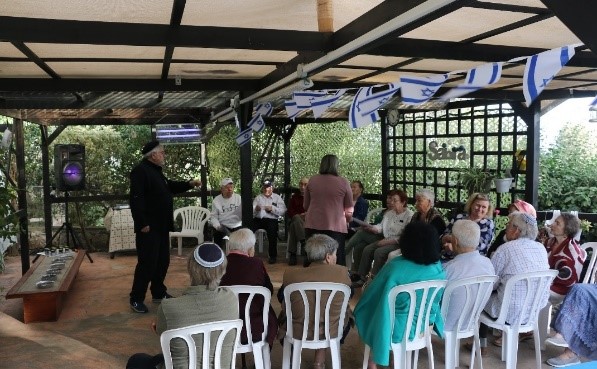
    Together with the Holocaust Survivors who are still able to come to Sabra (we pick them up and bring them back home) we remembered Yom HaShoah (Holocaust). Also the vice Mayor of Afula visited Sabra for this event. We shared memories and lighted candles. It was a beautiful day and despite the sad memories, they were happy for this moment together. A moment of recognition, sharing their painful memories and lighting candles. A sad day, also for me, but a warm feeling that we were together and were able to give them a little bit of comfort.

    Below you can read some feelings of our volunteer from Holland, “Hannah-Leah”:

    I have the privilege to live in Israel and to serve my God in Sabra and be a part of this precious work. Not always easy, but I am so in awe that I can do it. Momentarily my work is concentrated in Jerusalem, Holon and the boarding school near Gaza, but of course, I regularly go to Sabra in Afula.                                                                 

    For the meeting on Yom HaShoah I was present in Sabra. This day touched me so much, being together with the Holocaust Survivors. Not only sharing the pain of their memories, but also the loss of Salomon and the pain of Rima and Sophia who lost her husband Jacob. Beside that, there was sadness about the war Russia/Ukraine; many of them have still family there.

    They shared their stories with us. One story touched me deeply: after surviving the horror of the Holocaust and managing to return to the city they lived in before, their house had been confiscated by other people and all their possessions were gone! They experienced very strong anti-Semitism even by their former neighbors. They were beaten and verbally abused. They had no place to go to and no one helped them. This was so painful. They were so ashamed, and therefor they never shared it with anyone. Again I felt so privileged to be a part of this holy work.                                                                                                                                

    Please pray for them, for Sabra ~ Hannah-Leah